
Have you ever wondered how color works in the digital format? I have too! First, you need to know that reflected color (ink) and projected color (the screen on your computer or phone) are two very different things. Reflected colors work in the physical world, like on paper. Light shines on an object which will absorb some colors and reflect others. The reflected colors reach your eyes which are the colors that you see!
Projected color, however, functions differently. Screens will generate their own light and combine colors to create what you see. They directly emit the light into your eyes. For example, a red apple on your table is red because it reflects red light and absorbs other colors. Contrarily, a red apple emoji on your phone is red because your screen emits red light to simulate the color.

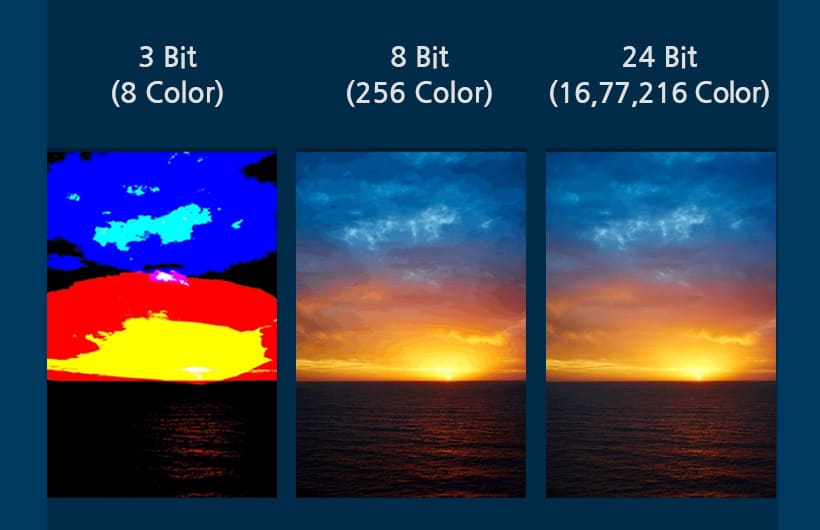
With digital images, color is represented in numerical codes that our screens transform into pictures. Indexed color is like coloring with a limited number of crayons in your box. The bit depth of a picture determines how many colors are used to color the pixels in that image, while the resolution determines how many pixels are in the image. For example, imagine a picture with 8 bits. It would allow you to use 256 colors, whereas a picture with 3 bits would allow you to use only 8 colors.
When you want just about all the colors in the universe, that’s when you use 24 bit color! Here, each pixel is a mix of Red, Green, and Blue (RGB), with 8 bits (256 shades) for each channel. That leaves 16.7 million possible colors! For example, a picture of a beautiful sunset might be represented with 24 bit color which allows it to have a very high resolution and tons of intricate detail.